
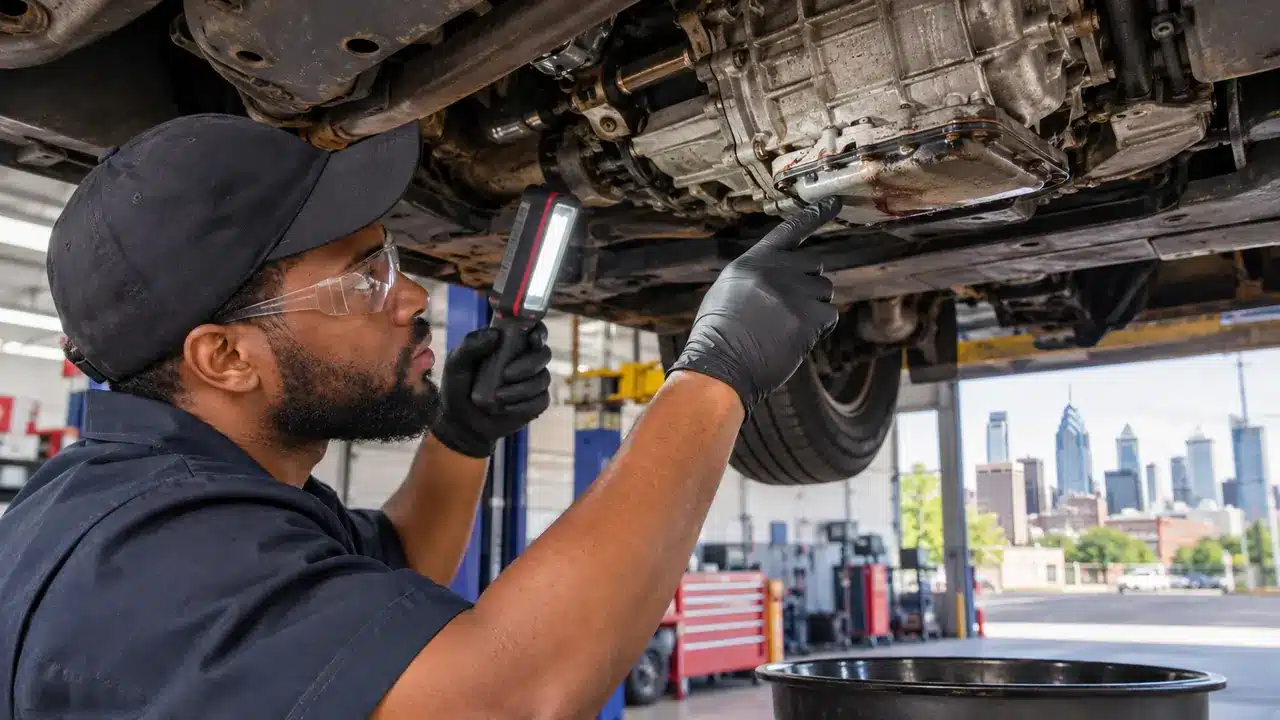
Signs of transmission failure can start with something as ordinary as a slow shift into Drive, a shudder at a traffic light, or an engine that revs without the car picking up speed. Some symptoms appear only when the vehicle is cold. Others become noticeable after a long commute.
Not every strange shift means the entire transmission needs replacing. Low fluid, a leak, worn mounts, electrical faults, and engine problems can resemble more serious transmission damage. The useful question is not simply, “Is my transmission bad?” It is, “What exactly is happening, how urgent is it, and what should be tested before I pay for a repair?”
This guide explains nine signs of transmission failure, when to stop driving, what a qualified inspection should include, and how to compare repair with replacement. Recognizing signs of transmission failure early can help you describe symptoms accurately and avoid guessing about expensive parts.
Table of Contents
- Nine warning signs and what they can mean
- Which symptoms mean you should stop driving?
- Transmission trouble or an engine problem?
- Why transmissions develop problems
- How a professional diagnosis works
- Will a transmission fluid change solve slipping?
- Repair, rebuild, or replacement?
- What to tell the mechanic
- Preventing avoidable transmission damage
- Common questions
- Transmission help in Philadelphia
9 Signs of Transmission Failure and What They Actually Mean
These signs of transmission failure are clues, not a diagnosis. Modern vehicles use conventional automatic transmissions, continuously variable transmissions (CVTs), dual-clutch units, and manual gearboxes. The same behavior can mean different things in each design. Notice what changed from your car’s normal operation, and look for symptoms that occur together.
1. The Engine Revs, but Acceleration Feels Weak
You press the accelerator to join traffic. The engine speed rises, but the vehicle moves forward slowly or only catches up after a hesitation. Drivers often describe this as transmission slipping.
In a conventional automatic transmission, internal clutches and hydraulic controls help transfer engine power to the wheels. Low pressure, worn friction parts, or another internal fault can cause an engine-speed flare without normal acceleration. In a manual car, a slipping clutch can create a similar effect.
However, many CVTs allow engine speed to rise while road speed builds more gradually. That can be normal. An abrupt change in how your specific vehicle accelerates is more meaningful than engine RPM alone.
Among the signs of transmission failure, repeated loss of acceleration deserves particular attention because it can make merging or crossing an intersection unpredictable. If the vehicle cannot accelerate safely, stop driving and arrange a tow. Do not assume that a transmission fluid change will repair worn internal components.
2. Drive or Reverse Takes Too Long to Engage
Imagine starting the car, keeping your foot on the brake, selecting Drive, and waiting for the vehicle to respond. The gear may engage a moment later with a thump. Reverse might work normally, or the delay might occur in both directions.
Delayed engagement is one of the signs of transmission failure that drivers can document without special equipment. Note whether it happens after an overnight stop, only after the vehicle warms up, or every time you select a gear.
Possible causes include an incorrect fluid level, leaks, hydraulic pressure problems, valve-body faults, or internal clutch wear. Some electrical faults can also alter gear engagement. The symptom does not identify which of these is responsible.
Never rev the engine to force a delayed gear to engage. If it engages suddenly, the car can lurch. A technician should inspect the cause before you continue regular use.
3. Shifts Are Suddenly Hard, Jerky, or Unpredictable
Your vehicle used to change gears smoothly, but now it bangs into second gear, jolts during a downshift, or jerks as you slow to a stop. Harsh shifting can be uncomfortable and may indicate a developing fault.
These signs of transmission failure sometimes involve a shift solenoid, transmission control software, hydraulic pressure, or mechanical wear. But an engine misfire, failed mount, or other drivetrain issue may feel like a hard shift from the driver’s seat.
Tell the technician which shift feels wrong and when it occurs. “It jerks between first and second gear when cold” is more helpful than “the gearbox feels rough.” If shaking also happens while the car is idling, ask for engine-related checks rather than authorizing transmission work immediately.
4. The Vehicle Refuses to Shift or Stay in Gear
A transmission may stay in a low gear, hesitate to upshift, drop out of gear, or fail to select Reverse. Some vehicles enter a reduced-power or restricted-gear mode after the computer detects an operating fault.
Difficulty remaining in gear is among the more serious signs of transmission failure because the car may lose drive when you need it. The cause could be electronic, hydraulic, or mechanical. A fault code may provide direction, but it is not proof that the entire unit has failed.
If the car will not reliably move or maintain a selected gear, have it transported for diagnosis. A transmission replacement evaluation in Philadelphia should follow testing, not precede it.
5. You Hear New Whining, Grinding, or Clunking Sounds
A new whining noise may seem to come from underneath the car. A manual gearbox might grind during a shift. An automatic may make an unfamiliar clunk as power engages. The source could involve bearings, gears, hydraulic components, or other drivetrain parts.
Sounds alone are not reliable signs of transmission failure. Wheel bearings, CV joints, differentials, and even loose exhaust parts can transmit noise through the vehicle. A technician will want to know whether the sound follows engine RPM, road speed, or a specific gear change.
Avoid driving with severe grinding or a sudden loss of drive. If the noise is mild but new, book an inspection and describe exactly when it occurs.
6. The Car Shudders at a Particular Speed or Load
Some drivers describe a shudder that feels like driving across rumble strips. It may happen under light acceleration or while holding a steady speed. In certain automatic transmissions, the torque converter lockup clutch can contribute to this feeling when it does not operate smoothly.
Yet shuddering is also associated with ignition misfires, engine mounts, tires, axles, and other components. It is one of the less specific signs of transmission failure and should never be used by itself to justify a torque converter replacement.
If the vibration occurs with rough idling or a misfire code, the technician may need to check the engine first. Depending on the results, a professional engine repair inspection or engine light diagnostic service may help isolate the cause.
7. Transmission Fluid Appears to Be Leaking
A stain where you normally park can be a useful early clue. Some automatic transmission fluids are red or amber when new, but color changes with formulation and age. Power steering fluid, engine oil, and coolant can sometimes be confused with a transmission leak.
A leak matters because fluid helps cool and lubricate the transmission, and many automatics also rely on it for hydraulic control. If the fluid level falls, the transmission may slip, overheat, or engage gears poorly.
Fluid leaks are signs of transmission failure risk, not proof of a destroyed transmission. A worn seal, damaged line, or leaking gasket may be repairable before substantial damage occurs. Ask for the source of the leak to be identified instead of simply topping up the reservoir.
Do not add an unknown fluid. CVTs, dual-clutch gearboxes, and conventional automatics can require different specifications, and many vehicles have no simple dipstick procedure. Learn about transmission fluid service in Philadelphia before choosing a maintenance procedure.
8. There Is a Burning Smell or Temperature Warning
If the vehicle develops a hot, acrid smell or displays a transmission temperature warning, stop treating it as an ordinary shift-quality complaint. Excessive heat can affect fluid performance and accelerate wear inside a transmission.
Still, a burning odor does not identify the source. Brakes, electrical wiring, engine oil on hot components, or other vehicle systems can produce similar smells. Smoke or an overheating warning requires prompt attention regardless of the cause.
These signs of transmission failure are especially concerning when paired with slipping, fluid loss, or poor acceleration. Follow the owner’s manual instructions for any warning message. If smoke appears or the vehicle is unsafe, stop and seek assistance rather than attempting to finish the drive.
9. A Transmission or Check Engine Warning Appears
A transmission warning may point toward abnormal temperature, gear-ratio behavior, electrical controls, or other monitored faults. Some vehicles use the check engine light rather than a dedicated transmission indicator.
A warning light is not a verdict. A basic scanner might report a gear-ratio or solenoid-related code, but the technician still needs to verify the relevant circuit, fluid condition, hydraulic behavior, and other possible causes.
Some signs of transmission failure do not trigger a dashboard light at all. That is why unusual shifting should still be inspected even when the dashboard looks normal. An automotive computer diagnostic appointment may be the starting point, with additional transmission-specific testing as necessary.
Which Signs of Transmission Failure Mean You Should Stop Driving?
The most urgent signs of transmission failure are the ones that make vehicle movement unpredictable. A car that will not remain in gear or accelerate reliably is not suitable for normal traffic, even if it can still move around a parking lot.
| What happens | Sensible next step |
|---|---|
| Slightly rough shift with no other symptoms | Arrange an inspection and monitor for changes |
| Repeated delay in selecting Drive or Reverse | Minimize unnecessary driving and book diagnosis |
| Engine revs but acceleration is unreliable | Pull over safely and arrange a tow |
| Vehicle loses drive or cannot stay in gear | Do not continue driving |
| Strong burning smell, smoke, or a temperature warning | Stop safely; follow the owner’s manual and request assistance |
| Major fluid leak or loud mechanical grinding | Avoid driving until the cause is checked |
There is no universal number of miles you can safely drive with a slipping transmission. If the transmission stops transferring power at an intersection, the consequences matter more than the distance to the shop.
Transmission Problem or Engine Problem? Avoid This Common Mix-Up
Drivers searching for signs of transmission failure often report jerking, hesitation, or sluggish acceleration. Those are real symptoms, but not all originate inside the transmission.
| Symptom | Transmission-related possibility | Another possibility |
|---|---|---|
| RPM rises without matching speed | Internal slipping or clutch problem | Normal operating behavior in some CVTs |
| Vehicle jerks under acceleration | Harsh gear engagement | Engine misfire or worn mount |
| Car shudders at steady speed | Torque converter clutch issue | Tire, axle, or ignition problem |
| Poor acceleration | Incorrect gear engagement | Engine power or fuel-delivery fault |
| Clunk when selecting a gear | Engagement or internal drivetrain fault | Worn motor or transmission mount |
Consider a real-world scenario: a car shudders when accelerating, but the engine also idles unevenly and has misfire codes. Replacing the transmission before diagnosing the misfire could mean spending money without solving the problem.
That distinction is why the guide to professional vehicle diagnostics can be useful before approving a major repair. Check engine symptoms may warrant ignition coil testing and replacement if the diagnosis supports it.
What Actually Causes These Transmission Warning Signs?
Several systems can create signs of transmission failure, and the cost of resolving them varies widely.
Fluid level and condition. Low fluid, contamination, or the wrong fluid specification can interfere with lubrication, heat management, and hydraulic operation. Correcting a leak and fluid level may help if internal damage has not already occurred.
Electronic controls. A sensor, electrical connection, solenoid, or control issue can affect when and how some transmissions shift. Such faults do not always require replacement of the whole unit.
Internal wear. Clutch packs, bearings, gears, and other mechanical parts can deteriorate. When damage is extensive, a repair or fluid service may no longer be sufficient.
Heat and workload. Overheating, towing beyond vehicle limits, or continued driving while the transmission slips can contribute to more severe problems.
A useful question for the mechanic is: “Which test demonstrates that this specific part has failed?” The answer should distinguish confirmed findings from possibilities.
How a Mechanic Should Diagnose Signs of Transmission Failure
A trustworthy inspection begins with the symptoms, not a replacement quote. The Federal Trade Commission’s automotive repair guidance specifically recommends checking simpler possible causes before treating transmission complaints as expensive internal failures.
First, describe the driving conditions
Tell the technician whether the issue happens while cold, after a long drive, during acceleration, or when selecting Reverse. Give the year, make, model, mileage, transmission type if known, and recent service history.
Next, check data and visible components
A diagnostic process may involve reading stored fault codes, examining live operating data, inspecting relevant wiring or mounts, checking for leaks, and evaluating fluid condition using the manufacturer’s procedures.
Finally, verify the proposed repair
Depending on the complaint, further testing may involve electrical checks, hydraulic-pressure measurements, or evaluation of internal mechanical operation. A trouble code alone does not establish that a complete transmission is defective.
When discussing signs of transmission failure with a shop, request an explanation of what was tested, what was confirmed, and which alternatives were ruled out. Ask for a written estimate and details of any repair warranty.
Can Changing Transmission Fluid Fix Signs of Transmission Failure?
Sometimes, but not always. A correct fluid service may help when the complaint is genuinely related to fluid level or condition. It cannot replace broken gears, restore severely worn friction material, or repair a faulty electrical component.
One mistake is assuming that every instance of slipping requires a transmission flush. A flush or fluid exchange is a maintenance procedure, not a diagnosis. The proper method depends on the transmission design, service history, and manufacturer’s recommendations.
Some signs of transmission failure appear soon after a fluid service. In that situation, verify the fluid specification, level, and service procedure before assuming the transmission has independently failed.
For related maintenance advice, read when a transmission fluid change may be needed and what can happen when transmission fluid service is delayed. For manufacturer-independent guidance, AAA explains transmission fluid maintenance.
Repair, Rebuild, or Replace: Which Choice Makes Sense?
Discovering signs of transmission failure can be stressful because replacement is a major expense. But a correct repair decision depends on the damage found, parts availability, vehicle condition, and total estimate.
| Option | When it may fit | What to ask |
|---|---|---|
| Targeted repair | A confirmed, accessible leak, sensor, solenoid, or other repairable issue | Does testing show the rest of the transmission is healthy? |
| Rebuild | Internal wear or damage that can reasonably be repaired | Which parts and labor are included? |
| Used replacement unit | A compatible unit is available at an acceptable price | What is its history, mileage, and warranty? |
| Remanufactured or new replacement | Extensive damage or a more suitable replacement is available | What are the parts and labor warranties and installation requirements? |
Do not compare prices without comparing what is included. Fluid, seals, programming, cooling-system checks, labor, and warranty coverage can affect the total. A low-cost used unit with uncertain condition can be a different risk from a remanufactured unit with defined coverage.
The transmission replacement service page provides a relevant next step if diagnosis confirms major damage. If engine condition is also affecting the decision, compare it with the shop’s engine replacement service rather than treating one expensive repair in isolation.
What Information Should You Bring to Your Appointment?
A clear description of signs of transmission failure can reduce guesswork. You do not need to diagnose the vehicle yourself. A few observations are enough:
- Does the issue happen when cold, warm, or both?
- Is the problem in Drive, Reverse, or a particular shift?
- Does RPM rise without matching acceleration?
- Are there visible leaks, strange noises, odors, or dashboard warnings?
- Was the transmission recently serviced or repaired?
- Does the car also idle roughly or shake when not shifting?
For example, “After sitting overnight, my car takes several seconds to engage Drive, but Reverse works normally” provides more useful information than “the transmission is dying.”
If your vehicle is unsafe to operate, do not perform repeated test drives to collect evidence. Describe what you observed before stopping. The mechanic can determine appropriate tests in a controlled setting.
How to Reduce the Risk of Transmission Failure
Maintenance will not prevent every failure, but it can reduce avoidable problems. Follow the vehicle manufacturer’s fluid specifications and service intervals, including any separate schedule for severe driving conditions.
Treat leaks and unexplained shifting changes as inspection items. When moving between Drive and Reverse, come to a complete stop unless the owner’s manual says otherwise. Do not overload the vehicle or tow beyond its rated capacity.
A useful vehicle maintenance service can help identify overdue items. For transmission-specific maintenance, see the shop’s transmission oil change service.
Most importantly, remember that signs of transmission failure warrant investigation, not panic. The signs of transmission failure may point to a manageable leak or control fault, which is why identifying the cause early matters more than guessing from the symptom.
Questions Drivers Ask About Signs of Transmission Failure
What are the earliest signs of transmission failure?
Common early symptoms include a noticeable delay into Drive or Reverse, occasional slipping, unfamiliar shift harshness, or a new shudder. These symptoms warrant inspection, but none proves that the entire transmission has failed.
Can signs of transmission failure come and go?
Yes. Some faults change with temperature, fluid pressure, or driving conditions. An intermittent symptom is still worth documenting and diagnosing rather than dismissing when it disappears.
What should I do when I notice signs of transmission failure?
Write down when the problem occurs, avoid unnecessary driving if acceleration or gear engagement is unreliable, and book an inspection. If the vehicle loses drive, overheats, or behaves unpredictably in traffic, stop safely and arrange a tow.
Will a bad transmission always turn on a warning light?
No. Some mechanical or hydraulic problems may occur without a useful dashboard warning or stored code. A scanner is one diagnostic tool, not a substitute for the entire inspection.
How long can I drive with a slipping transmission?
No fixed distance is reliably safe. If slipping affects your ability to accelerate or maintain speed, stop driving and arrange transport. Waiting for complete failure can create a dangerous situation.
Does rough shifting always mean transmission replacement?
No. Harsh shifts can come from electronic controls, fluid-related problems, mounts, engine issues, or internal wear. Diagnosis determines whether a targeted repair, rebuild, or replacement is appropriate.
Can the transmission be failing even if Reverse still works?
Yes. Different gears and operating modes use different controls and components. A transmission that works normally in Reverse may still have a significant Drive-related fault, or vice versa.
Get the Cause Checked Before Approving Major Work
The most important thing about signs of transmission failure is that symptoms and diagnoses are different. Slipping, leaks, delayed engagement, overheating, and harsh shifts all deserve attention, but they do not automatically justify a new transmission.
At 8 Cylinders Auto Repair in Philadelphia, drivers can request transmission-related inspections and discuss appropriate service or replacement options based on the vehicle’s condition. If your car is not safe to drive, arrange towing rather than attempting to bring it in under its own power.
Location: 3311 N 13th St, Philadelphia, PA 19140
Phone: (267) 667-1766
Next step: Book an inspection with 8 Cylinders Auto Repair
A clear diagnosis gives you a better basis for deciding whether to repair the current unit, explore replacement, or address another part of the vehicle first.