
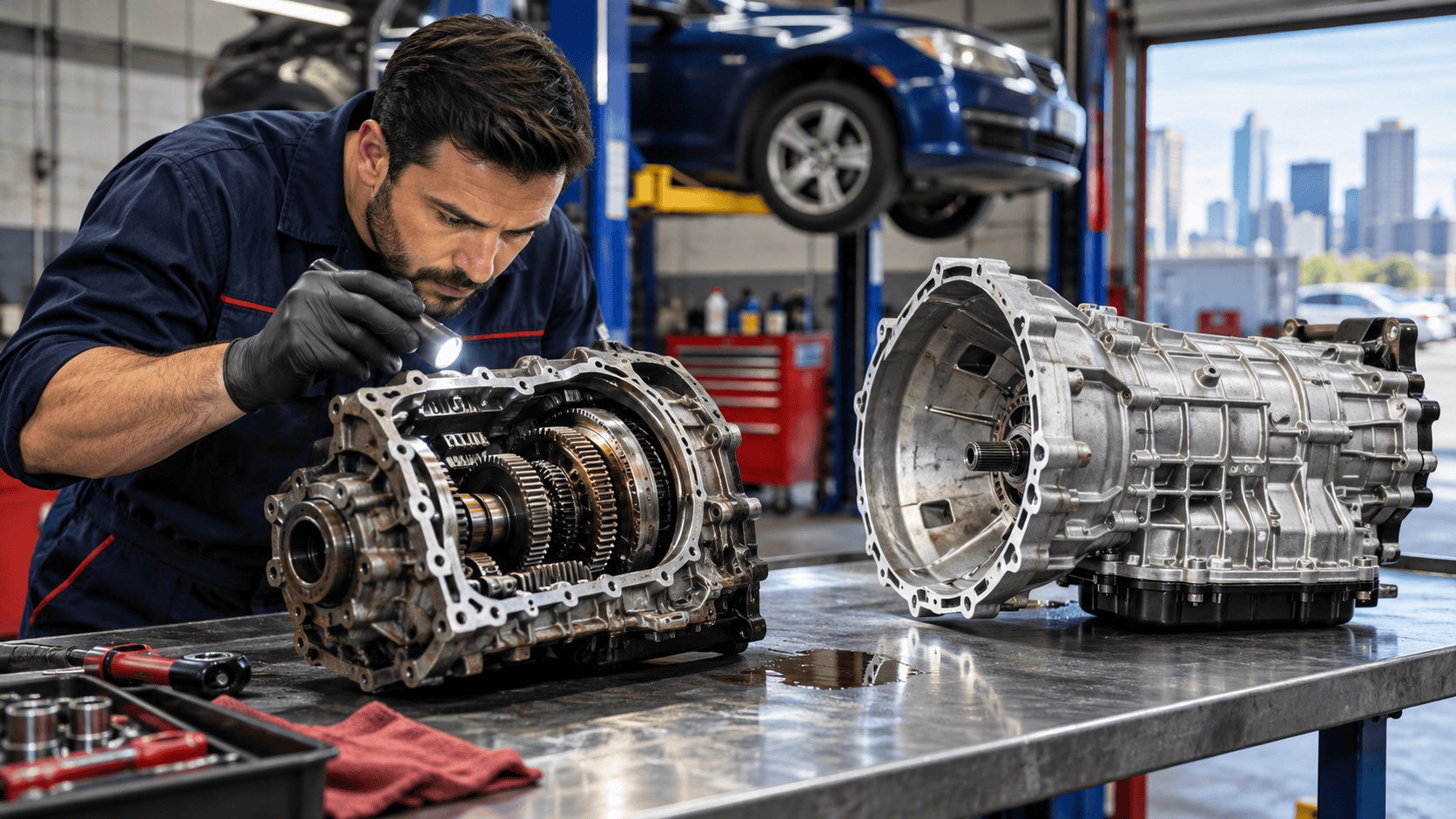
Transmission repair vs replacement is one of the most expensive decisions a vehicle owner may face. Your car starts slipping between gears, hesitates when you accelerate, or refuses to shift into reverse. A mechanic mentions transmission problems, and suddenly you’re wondering whether a smaller repair will solve the issue or whether the entire transmission needs replacing.
The answer depends on what actually failed, how much internal damage exists, your vehicle’s condition, and how long you plan to keep driving it.
A transmission that shifts roughly does not automatically need replacement. Some problems originate from fluid leaks, electrical components, or faulty controls. Others involve extensive internal wear that makes replacing the transmission more practical than attempting isolated repairs.
Understanding transmission repair vs replacement helps you compare estimates, recognize unnecessary work, and choose a solution that makes financial sense.
Table of Contents
- Transmission Repair vs Replacement: Understanding Your Options
- Warning Signs That Help Determine the Right Solution
- When Transmission Repair Makes More Sense
- When Replacing the Transmission Is the Better Choice
- Transmission Repair vs Replacement Cost Comparison
- Used, Rebuilt, and Remanufactured Transmissions
- Seven Factors That Should Guide Your Decision
- What Happens During Transmission Diagnosis?
- Common Mistakes That Make Transmission Problems More Expensive
- How Long Can a Repaired or Replaced Transmission Last?
- Frequently Asked Questions
- Get Professional Transmission Help in Philadelphia
Transmission Repair vs Replacement: Understanding Your Options
Transmission repair addresses a specific problem within the existing transmission system. Transmission replacement involves removing the existing gearbox and installing another compatible unit.
The distinction matters because a transmission contains many mechanical, hydraulic, and electronic components. A problem with one component does not necessarily mean the entire assembly has failed.
What Does Transmission Repair Involve?
Transmission repair focuses on identifying and correcting a particular fault.
Depending on the vehicle and diagnosis, the repair may involve replacing a leaking seal, repairing wiring, addressing a faulty shift solenoid, or correcting a valve body problem.
Some repairs can be completed without removing the transmission. Others require substantial disassembly.
For example, imagine a vehicle begins shifting harshly after a transmission control problem develops. If diagnostic testing confirms an accessible electrical fault and the internal mechanical components remain healthy, a targeted repair may restore normal operation.
Replacing the complete transmission in that situation could be unnecessary.
What Happens During Transmission Replacement?
Transmission replacement means removing the existing transmission and installing a different compatible assembly.
The replacement may be new, used, rebuilt, or remanufactured.
A technician must verify compatibility, inspect related components, install the replacement, fill it with the correct transmission fluid, and complete any required programming or adaptation procedures.
Depending on the vehicle, the process may also involve inspecting the torque converter, cooler, transmission mounts, axles, and related drivetrain components.
A properly installed replacement should also be tested to confirm that the original symptoms have been resolved.
Drivers considering this option can learn more about transmission replacement in Philadelphia.
Is Transmission Rebuilding the Same as Repairing?
Not exactly.
A targeted transmission repair addresses one or more identified faults.
A transmission rebuild involves disassembling the gearbox, inspecting internal components, replacing damaged or worn parts as required by the rebuild scope, and reassembling the unit.
Rebuilding may make sense when several internal components need attention but the transmission case and other major components remain usable.
The important distinction is that a limited repair, an overhaul, and a complete rebuild may involve very different amounts of work.
Ask your mechanic to explain exactly what the quoted service includes.
Warning Signs That Help Determine the Right Solution
Recognizing symptoms can help you explain the problem to a mechanic, but symptoms alone cannot establish whether transmission repair vs replacement is necessary.
Different mechanical and electrical problems sometimes produce nearly identical driving behavior.
Slipping Gears During Acceleration
Transmission slipping may feel like your engine is accelerating without a corresponding increase in vehicle speed.
Possible causes include low hydraulic pressure, worn internal clutches, fluid problems, or torque converter faults.
In a manual vehicle, a worn clutch can create similar symptoms without requiring replacement of the gearbox itself.
Some continuously variable transmissions also operate at relatively high engine speeds during acceleration. The concern is an unusual change in your vehicle’s normal behavior.
Repeated slipping warrants professional diagnosis, especially when acceleration becomes unreliable.
Delayed Engagement When Selecting Drive or Reverse
You shift from Park into Drive, but the vehicle hesitates before moving.
The delay might occur only when the engine is cold or become noticeable after driving.
Possible causes include fluid pressure problems, internal wear, or faulty transmission controls.
Some causes are repairable. Others indicate more substantial damage.
A technician needs to determine why engagement is delayed before recommending major work.
Grinding, Whining, or Clunking Noises
Unusual noises can develop from worn bearings, damaged gears, or other drivetrain components.
However, not every noise comes from the transmission.
Wheel bearings, axles, differentials, and other mechanical systems can produce similar sounds.
A proper inspection should establish where the noise originates before any transmission work is authorized.
Burning Smell or Overheating
Transmission fluid helps with lubrication, cooling, and, in many automatic transmissions, hydraulic operation.
Overheating can affect fluid performance and accelerate internal wear.
A burning odor may indicate a transmission problem, but it can also come from brakes, engine oil, or electrical components.
If your vehicle displays a transmission temperature warning, develops smoke, or begins losing driving power, pull over safely and arrange professional assistance.
Transmission Fluid Leaks
A visible fluid leak does not automatically mean the gearbox needs replacement.
A damaged seal, gasket, cooler line, or other external component may be responsible.
However, continuing to drive with insufficient fluid can lead to much more serious damage.
Have the leak identified and repaired before the transmission operates with inadequate lubrication or hydraulic pressure.
For additional warning signs, see our guide to 9 signs of transmission failure.
When Transmission Repair Makes More Sense
Transmission repair is generally worth considering when the problem can be isolated, the remaining transmission components are serviceable, and the total repair cost is reasonable.
The Damage Is Limited to a Specific Component
Suppose an inspection identifies a leaking external seal and no evidence of significant internal damage.
Correcting the leak and restoring the proper fluid level may be enough.
Similarly, certain electronic problems can be resolved without replacing the complete assembly.
The key is confirming that the fault has not already caused additional damage.
The Transmission Is Mechanically Healthy
Some vehicles experience shifting problems caused by electronic controls rather than extensive mechanical wear.
Faulty wiring, sensors, or shift-control components may affect how the gearbox operates.
If testing confirms that the internal components are functioning correctly, replacing the complete transmission may offer little advantage over correcting the identified fault.
The Repair Has a Reasonable Cost and Warranty
A smaller repair may be financially attractive when it directly addresses the confirmed problem and includes appropriate workmanship coverage.
However, price alone should not determine the decision.
A repair that costs less today but leaves known internal damage unresolved may not be a good investment.
Ask whether the mechanic expects the proposed repair to correct the underlying issue or simply restore limited operation.
The Vehicle Has No Other Major Problems
Transmission repair can make sense when the engine, suspension, electrical system, and other important components are in satisfactory condition.
If the vehicle is otherwise dependable, correcting a localized transmission problem may extend its useful life without requiring a major replacement.
Important: A repair is only the better value when there is reasonable evidence that it will solve the diagnosed problem.
When Replacing the Transmission Is the Better Choice
Transmission replacement becomes more attractive when internal damage is extensive, rebuilding is impractical, or a suitable replacement provides better value and warranty coverage.
Multiple Internal Components Have Failed
Automatic transmissions contain clutch assemblies, hydraulic components, gears, shafts, bearings, and other precision parts.
When extensive wear or damage affects several components, an isolated repair may not address the entire problem.
For example, replacing a faulty solenoid will not restore worn clutch friction material.
If significant metal debris is found inside the transmission, a technician may recommend a rebuild or replacement after evaluating the extent of the damage.
The Transmission Has Experienced Major Mechanical Failure
A damaged case, broken internal gear assembly, or widespread mechanical failure can make the existing transmission uneconomical to repair.
In these situations, replacing the unit may provide a more practical path to restoring reliable operation.
The decision still depends on parts availability, vehicle design, and replacement costs.
Repair Costs Approach Replacement Costs
Imagine a mechanic provides two estimates.
A major internal repair costs $3,800, while a compatible remanufactured transmission with installation costs $4,500.
The repair costs less initially, but the replacement may include a different warranty and a broader scope of renewed components.
Those differences may justify considering the replacement.
These are hypothetical amounts, not current shop quotes.
Previous Repairs Have Not Solved the Problem
Repeated transmission repairs deserve closer examination.
If the same symptoms return, the original diagnosis may have been incomplete, or additional failures may exist.
Rather than continuing to replace individual components, request a complete evaluation.
Sometimes a different targeted repair is justified. In other cases, rebuilding or replacing the transmission is more economical.
A Compatible Replacement Is Readily Available
Parts availability can influence the decision.
Certain transmissions have limited rebuild parts available, while suitable replacement assemblies may be easier to obtain.
However, the opposite can also happen.
Some replacement transmissions are expensive or difficult to source, making an in-house rebuild more practical.
Transmission Repair vs Replacement Cost Comparison
Transmission repair vs replacement costs depend on the specific vehicle, the fault, labor requirements, and the type of replacement unit selected.
A small external repair and a complete internal rebuild should never be treated as equivalent services.
| Service | What You Pay For | Main Consideration |
|---|---|---|
| Minor transmission repair | Diagnosis, specific components, and labor | Appropriate when damage is localized |
| Major internal repair | Significant disassembly and component replacement | May become costly if additional damage is found |
| Transmission rebuild | Disassembly, inspection, parts, and reassembly | Quality depends on workmanship and rebuild scope |
| Used transmission replacement | Salvage unit, installation, and related work | Lower initial unit price, but uncertain wear |
| Remanufactured replacement | Reconditioned assembly, installation, and related work | Compare process, testing, and warranty |
| New transmission replacement | New assembly and installation | Availability and total cost vary significantly |
Why Transmission Repair Costs Vary
Two vehicles with similar symptoms may require completely different repairs.
A leaking transmission line may be accessible without removing major components.
Repairing internal clutch damage, however, may require removing and disassembling the entire transmission.
The vehicle’s drivetrain layout also affects labor.
Front-wheel-drive, rear-wheel-drive, all-wheel-drive, and four-wheel-drive vehicles may require different removal procedures.
Specialized transmissions, including CVTs and dual-clutch units, can involve additional diagnostic and service requirements.
How Much Does Transmission Replacement Cost?
For general context, AAA’s guide to common car problems discusses complete transmission replacement costs of approximately $2,000 to $5,000 or more.
That is a broad informational range, not a Philadelphia-specific quote. Some modern vehicles can cost substantially more.
An accurate estimate should identify the transmission type, replacement source, labor costs, required fluids, programming, applicable taxes, and warranty terms.
The Hidden Costs That Matter
When comparing estimates, ask whether the following are included:
- Transmission removal and installation labor
- Torque converter replacement where appropriate
- Transmission cooler inspection, cleaning, or replacement
- Required fluids and filters
- Computer programming or adaptation procedures
- Related seals, mounts, and hardware
- Road testing and post-installation checks
- Warranty coverage for both parts and labor
A cheaper estimate can become more expensive if essential services are excluded.
Used, Rebuilt, and Remanufactured Transmissions: Which Is Better?
When replacement is recommended, the next decision is choosing the type of transmission.
There is no universal best option. Each comes with different costs, risks, and advantages.
Used Transmission
A used transmission usually comes from another vehicle, often through an automotive salvage supplier.
Its biggest advantage is the possibility of a lower initial purchase price.
However, its internal condition may be difficult to verify.
Even a transmission advertised as low mileage can have an uncertain maintenance history.
Before choosing a used transmission, ask about its source, reported mileage, compatibility, testing, and warranty.
Also ask who pays for removal and installation if the unit fails after fitting.
A parts-only warranty may leave the owner responsible for substantial labor charges.
Rebuilt Transmission
A rebuilt transmission has been disassembled and repaired or overhauled using replacement components.
The extent of the work depends on the rebuilder and the agreed scope.
One shop may replace failed components and certain wear items. Another may perform a much broader overhaul.
Ask for documentation explaining which components were inspected, replaced, or reused.
A well-executed rebuild can be a reasonable option, particularly when the transmission’s original case and major components remain usable.
Remanufactured Transmission
A remanufactured transmission is generally processed through a more standardized rebuilding program.
The process may include disassembly, cleaning, inspection, replacement of specified wear components, reassembly, and testing.
However, standards and procedures vary among suppliers.
The word remanufactured alone is not proof that every component is new or that the unit will never develop problems.
Compare the supplier’s specifications, quality-control procedures, warranty duration, and labor coverage.
What Real Vehicle Owners Consider
Discussions in automotive communities show why transmission decisions cannot be based on price alone.
Another discussion involving a GMC Sierra compared an in-house rebuild with a remanufactured replacement. The owners considered warranty length, internal upgrades, and the reputation of the rebuilding shop.
These are individual experiences, not controlled reliability studies. Still, they illustrate an important lesson: the cheapest estimate is not necessarily the lowest-risk option.
For any replacement, compare the complete installed price and written warranty rather than relying on labels.
7 Smart Factors That Should Guide Your Transmission Repair vs Replacement Decision
The following seven factors provide a practical way to compare your options.
1. Get a Confirmed Diagnosis Before Approving Major Work
A warning light or rough shift is not enough evidence to justify replacing a transmission.
Ask the mechanic what testing identified the problem.
A proper diagnosis may include scanning the engine and transmission control modules, inspecting fluid condition, checking for leaks, and performing model-specific tests.
If a shop recommends replacement without explaining the fault, consider requesting a second opinion.
2. Evaluate How Much Internal Damage Exists
A transmission with a minor external leak presents a different situation from one with failed internal friction components.
Ask whether the damage is isolated or widespread.
Also find out whether continued driving may have caused additional wear.
The more extensive the damage, the stronger the case may become for rebuilding or replacing the unit.
3. Compare Complete Estimates, Not Just the Headline Price
Request written estimates for the realistic options.
A proper comparison should account for parts, labor, fluids, additional services, programming, and taxes.
Also ask what happens if further damage is discovered during disassembly.
A repair estimate that can increase significantly after opening the transmission should be compared carefully against a fixed-scope replacement quote.
4. Consider the Vehicle’s Actual Condition
Vehicle age and mileage matter, but neither automatically determines whether repair is worthwhile.
A well-maintained older car may justify transmission work.
A newer vehicle with serious engine damage, structural deterioration, or multiple major problems may be a less attractive investment.
Think about the vehicle’s condition as a whole.
5. Decide How Long You Plan to Keep the Car
If you intend to keep your vehicle for several more years, reliability and warranty protection may carry greater weight.
Someone planning to sell an older vehicle soon may consider a different financial approach.
However, any repair should still restore safe and proper operation, and known defects must be disclosed where required.
6. Examine the Warranty Carefully
Warranty terms can make a substantial difference.
Ask about the duration, mileage limits, covered components, labor coverage, exclusions, and claim process.
For a replacement transmission, find out whether a future failure would require you to pay for another removal and installation.
The Automatic Transmission Rebuilders Association provides consumer information about diagnosis, written estimates, and warranty practices.
7. Compare the Repair With Your Other Transportation Options
Suppose a car is worth approximately $7,000 in working condition, and the total transmission replacement estimate is $4,000.
That does not automatically mean the repair is a poor decision.
Replacing the entire vehicle may require more money, financing, registration expenses, and the risk of purchasing another used car with unknown problems.
On the other hand, expensive transmission work may not be sensible if your existing vehicle also needs substantial engine, suspension, or structural repairs.
Compare the total cost of keeping the vehicle with the realistic cost of replacing it.
The goal is not simply to spend less today. It is to make a financially reasonable decision for the transportation you need.
What Happens During Professional Transmission Diagnosis?
An accurate diagnosis helps prevent unnecessary repairs and reduces the chance that a replacement will fail because the original problem was never corrected.
Step 1: Discuss the Symptoms
The technician should ask when the problem started and under what conditions it occurs.
Useful details include whether shifting problems happen when the vehicle is cold, during acceleration, after long drives, or while selecting reverse.
A clear description can help narrow the diagnostic process.
Step 2: Check for Diagnostic Trouble Codes
Modern vehicles use electronic controls to monitor transmission operation.
A diagnostic scan can identify stored faults and provide useful direction.
However, a code does not automatically prove that a particular component needs replacement.
Further testing is often necessary to confirm the underlying cause.
For help identifying electronic faults, visit our computer diagnostics service in Philadelphia.
Step 3: Inspect the Transmission Fluid and Related Components
Depending on the manufacturer’s service procedure, the mechanic may check fluid level, condition, leaks, connections, and related components.
Low fluid can affect hydraulic pressure and shifting.
Contamination, unusual debris, or evidence of overheating may suggest internal damage.
However, fluid color alone does not determine whether a transmission is healthy or failed.
Step 4: Perform Further Testing
Additional testing may include checking hydraulic pressure, reviewing transmission data, evaluating electrical circuits, and road testing when safe.
The specific procedure depends on transmission design.
A manual gearbox, conventional automatic, CVT, and dual-clutch transmission require different diagnostic considerations.
Step 5: Explain the Repair Options
After testing, the shop should explain what failed, which solutions are practical, and how much each option is expected to cost.
The recommendation should address both the immediate problem and the risk of future failure.
A written estimate helps you evaluate the choices without relying on guesswork.
Common Mistakes That Make Transmission Problems More Expensive
Some costly transmission decisions begin with understandable assumptions.
Recognizing these mistakes can help prevent unnecessary spending.
Assuming Every Shifting Problem Requires Replacement
Jerking, slipping, or delayed engagement can have several causes.
For example, an engine misfire may feel like a transmission problem when accelerating.
Replacing the gearbox without identifying the true cause may leave the original symptom unchanged.
An engine light diagnostic inspection can help when warning lights or engine-related symptoms are present.
Believing a Fluid Change Will Repair Internal Damage
Transmission fluid service is important maintenance, but it is not a universal repair.
Fresh fluid cannot restore damaged gears, worn clutches, or broken internal components.
AAA also cautions that changing transmission fluid will not correct an already damaged transmission.
If your car is slipping, have the underlying problem diagnosed before requesting a flush.
For normal maintenance information, see when to get a transmission fluid change and our transmission fluid service page.
Adding the Wrong Transmission Fluid
Different transmissions require specific fluid formulations.
Using an incompatible product can cause operating problems or damage.
Never assume that conventional automatic transmission fluid is appropriate for every CVT or dual-clutch gearbox.
Follow the vehicle manufacturer’s specifications.
Continuing to Drive With Severe Slipping
Some drivers continue driving because the vehicle still moves.
However, repeated slipping can generate heat and contribute to further damage.
It can also make acceleration unpredictable in traffic.
If your vehicle cannot reliably accelerate, remain in gear, or respond to driving inputs, stop driving and arrange a tow.
Buying a Used Transmission Without Checking Compatibility
Vehicle make and model alone may not establish that a replacement transmission is compatible.
Transmission codes, production variations, drivetrain configurations, electronic controls, and programming requirements can matter.
A compatible-looking used gearbox may not function correctly in your vehicle.
Confirm the exact unit before purchasing.
Ignoring the Cause of the Original Failure
A replacement transmission can develop problems if the conditions that damaged the original unit remain unresolved.
For example, a restricted or contaminated transmission cooler may need attention before another unit is installed.
Some vehicles also require updates, programming, or specific installation procedures.
Ask the mechanic how the original failure was identified and what will be done to prevent related issues from affecting the replacement.
How Long Can a Repaired or Replaced Transmission Last?
There is no reliable universal lifespan for a repaired, rebuilt, or replaced transmission.
Longevity depends on the vehicle’s design, transmission condition, repair quality, maintenance, driving conditions, and installation procedures.
After a Targeted Transmission Repair
A successful repair may provide years of additional use when the problem was isolated and the remaining components are healthy.
However, repairing one component does not make every other part of an older transmission new.
The remaining service life depends on its condition.
After a Transmission Rebuild
A properly performed rebuild can restore the operation of a worn transmission.
Its durability depends on workmanship, replacement components, internal inspection, and whether known failure causes were addressed.
A rebuild should not be assumed to last for any specific mileage without supporting evidence.
After Transmission Replacement
A suitable replacement can provide dependable service, but outcomes vary.
A used unit may already have considerable wear.
A rebuilt or remanufactured unit may offer additional inspection and component replacement, but quality varies by provider.
Maintenance and correct installation remain important regardless of the replacement type.
Maintaining Your Transmission After Service
Follow the manufacturer’s instructions for transmission fluid and maintenance.
Pay attention to changes in shifting behavior, unusual noises, leaks, or warning lights.
Avoid operating the vehicle with known overheating problems.
If you regularly tow heavy loads, drive in severe traffic conditions, or operate a commercial vehicle, check whether the manufacturer recommends a different maintenance schedule.
Professional transmission oil change services can help you follow the appropriate service requirements for your vehicle.
Frequently Asked Questions About Transmission Repair vs Replacement
Is It Cheaper to Repair a Transmission or Replace It?
A targeted transmission repair is often cheaper than complete replacement when the problem is localized.
However, major internal repairs can approach or exceed the cost of installing a rebuilt or remanufactured unit.
Compare complete estimates after confirming the diagnosis.
Is It Worth Repairing a Transmission on an Older Car?
It can be worthwhile if the vehicle is otherwise in good condition and the repair cost is reasonable compared with your transportation alternatives.
Vehicle age alone should not determine the decision.
Can You Repair a Transmission Without Removing It?
Yes. Some external leaks, electrical faults, and accessible control components can be repaired without removing the transmission.
Major internal mechanical work often requires removal or substantial disassembly.
Is a Rebuilt Transmission as Good as a New Transmission?
A properly rebuilt transmission may perform reliably, but it is not automatically equivalent to a new unit.
The outcome depends on the quality of the rebuilding process, the components used, testing, and workmanship.
Is a Used Transmission Worth Buying?
A used transmission may be reasonable when the purchase price is significantly lower and its condition, compatibility, and warranty are acceptable.
However, the potential cost of another installation should be considered if the used unit fails.
Can a Transmission Be Repaired After It Starts Slipping?
Sometimes.
Slipping may result from a repairable hydraulic or electronic fault, but it can also indicate internal clutch wear or other serious damage.
Testing is necessary to determine the cause.
Should I Replace My Transmission or Buy Another Car?
Compare the complete repair estimate with your vehicle’s condition, expected future maintenance, and the realistic cost of acquiring another dependable vehicle.
A large repair bill does not automatically mean replacing the vehicle is the better financial choice.
Can a Transmission Fluid Flush Fix Hard Shifting?
A fluid service may improve certain issues when the underlying problem is related to fluid condition and the manufacturer recommends the procedure.
However, it cannot repair broken mechanical parts or worn friction components.
Have persistent hard shifting diagnosed before authorizing fluid service.
How Do I Know if a Mechanic Is Recommending Unnecessary Transmission Replacement?
Ask for the diagnostic findings, the specific failure identified, and an explanation of why a smaller repair is unsuitable.
Request a written estimate that describes what the proposed replacement includes.
If the diagnosis is unclear, seek a second opinion from a qualified repair facility.
How Long Does Transmission Replacement Take?
The time depends on the vehicle, transmission type, parts availability, required programming, and additional repairs.
Ask your shop for a vehicle-specific schedule rather than relying on a general estimate.
Making the Right Transmission Decision Starts With an Accurate Diagnosis
Transmission repair vs replacement should never be decided based only on a warning light, mileage, or the first estimate you receive.
A smaller repair may be appropriate when the problem is limited to a serviceable component. A rebuild or replacement may make more sense when internal damage is extensive or when the cost of repairing the existing unit approaches the cost of a suitable replacement.
Before approving major work, understand what failed, compare the full costs, review warranty coverage, and consider how long you plan to keep the vehicle.
The right decision is the one supported by evidence, not assumptions.
Need Transmission Repair or Replacement in Philadelphia?
If your vehicle is slipping, shifting harshly, leaking transmission fluid, or having trouble engaging gears, 8 Cylinders Auto Repair can help evaluate the problem.
Our team provides transmission diagnostics, repair, and replacement services in Philadelphia, including installation of rebuilt and remanufactured transmissions.
Before committing to a major expense, get a professional assessment of your vehicle’s condition and available repair options.
Schedule a Transmission Inspection Today
Get clear answers about your transmission before making an expensive repair decision.